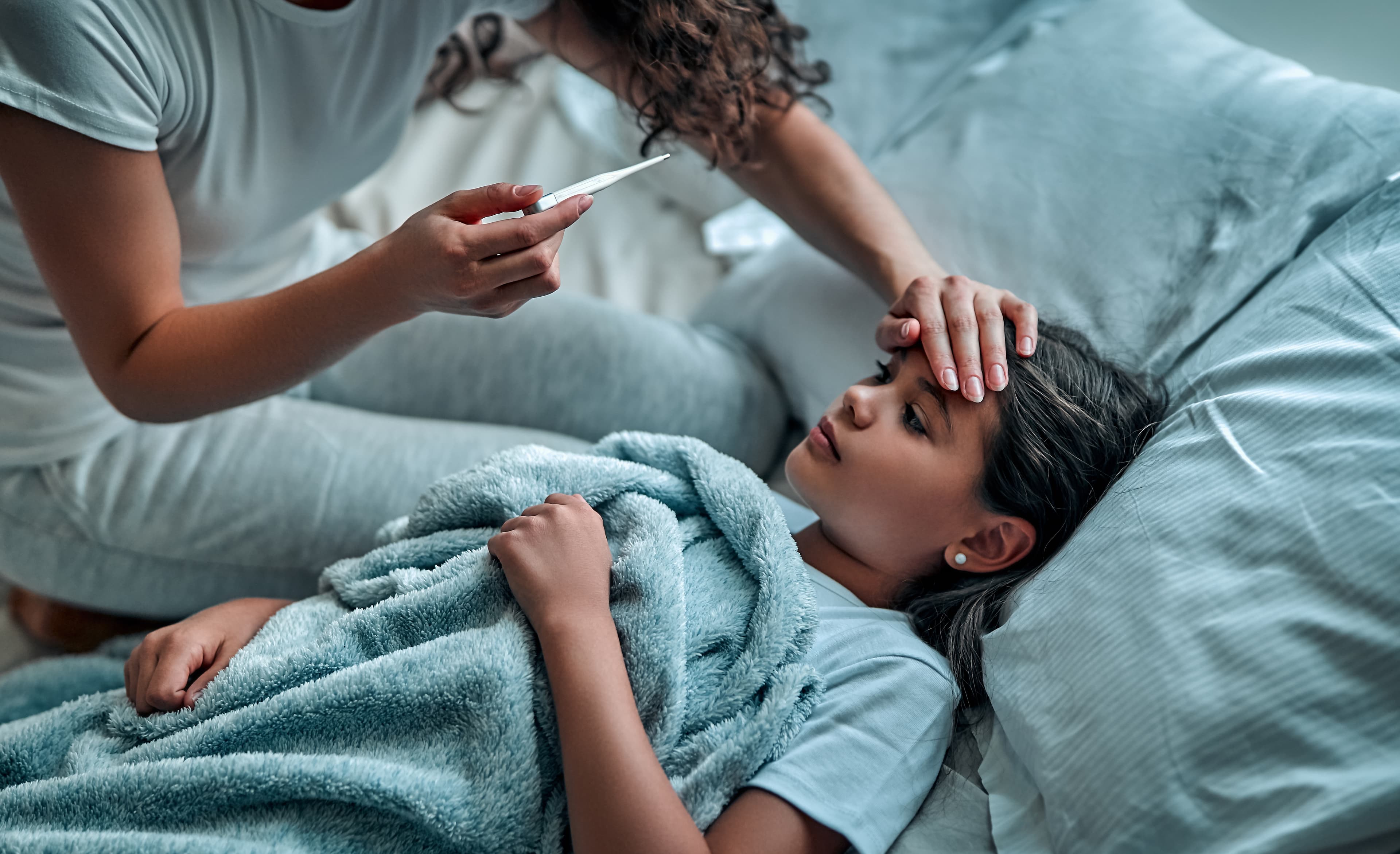
Every parent has been there. It's 2 a.m., your toddler feels hot, and your brain immediately spirals. Is this a real fever? Should I wake them up? Do I need to go to the ER? These questions hit hard, especially when you're exhausted and your child is uncomfortable.
Here's the thing though: most fevers in children are not emergencies. They're actually a sign that your child's immune system is doing exactly what it's supposed to do. The body raises its temperature on purpose, to create an environment that's harder for bacteria and viruses to survive in. That's not a malfunction. That's your kid's biology working.
But understanding that doesn't make those nighttime moments less stressful. Which is exactly why you need clear, accurate information before you're in that situation, not while you're scrambling in the dark.
This guide is written specifically for parents in Canada. We're covering everything: what a normal temperature actually looks like, how to read a fever temperature chart properly, how to use every type of thermometer correctly, what to do when your child gets a fever, what medications are safe and when, and, most importantly, when you actually need to pick up the phone or head to a clinic.
Whether you have a newborn at home or a school-age kid who picks up every cold going around, this guide is the one resource you'll want bookmarked.
What Is a Normal Temperature? Understanding the Numbers Before the Panic
Before you can understand what a fever is, you need to know what normal looks like. And this is where a lot of parents get confused, because "normal" isn't one single number. It's a range, and that range shifts depending on the child's age, time of day, activity level, and even how you're measuring.
In Canada, body temperature is measured in Celsius, so all numbers here are in °C.
A generally healthy body temperature for children sits somewhere between 36.5°C and 37.5°C. Now, within that range, there's natural fluctuation. A child who just woke up from sleep might read 36.5°C. The same child after running around the backyard might read 37.3°C. Both are completely normal.
What temperature is a fever? The widely accepted threshold in Canada, and in most of the world, is 38°C or higher. Below that, you're in normal-to-low-grade territory. At or above that mark, you've got a fever on your hands.
Here's a quick breakdown of how temperatures are generally classified:
Normal temperature: 36.5°C to 37.5°C Low-grade fever: 37.5°C to 38°C, the body is warming up, but this isn't quite a full fever yet Fever: 38°C and above, this is the threshold most Canadian health guidelines use High fever: 39°C and above, worth watching more closely Very high fever: 40°C and above, in most cases, this warrants a call to a healthcare provider
A 37.8 fever, for instance, sits right at that low-grade borderline. It means your child's body is working on something, but it's not necessarily time to reach for medication or panic. A 37.9°C reading is similar, slightly elevated, worth monitoring, but not an automatic emergency.
One thing worth understanding early: a fever in a 6-week-old infant is a completely different situation from a fever in a 5-year-old. As we get into the age-by-age sections of this guide, that difference will become very clear. For now, just know that younger = stricter = faster action needed.
The Children's Fever Temperature Chart, Reading It Right
A fever temperature chart gives you a quick reference for what readings mean across different measurement methods. The reason this matters is that every method gives you a slightly different number, and if you don't know the adjustment, you might think your child's temperature is higher or lower than it actually is.
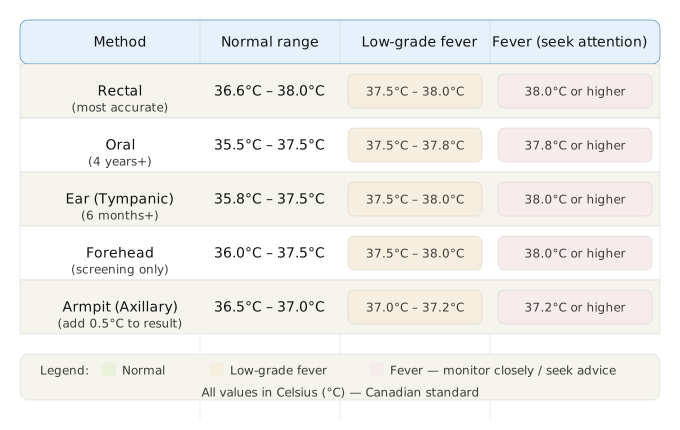
Here's what that chart tells you in plain terms: rectal temperature is the most accurate reading you can get, and every other method produces a number that's adjusted relative to rectal. Ear and forehead readings can vary quite a bit depending on technique, which is why a toddler fever temperature reading from a forehead thermometer should always be interpreted carefully.
For a child fever chart to be useful, you need to know which method you used. Always note the method when you're tracking readings. "38.2°C oral" means something slightly different from "38.2°C armpit", the oral reading is closer to core temperature, while the armpit temperature is typically 0.5°C lower than actual.
That's why if you take a baby temperature armpit reading and get 37.5°C, you'd mentally add about 0.5°C to estimate what the rectal temperature would be, putting that child closer to a real fever threshold than the raw number suggests. Normal baby temperature armpit sits around 36.5°C to 37°C, so anything above 37.2°C at the armpit is worth taking seriously in very young babies.
Types of Thermometers, Which One You're Actually Using Matters
Walk into any Shoppers Drug Mart or pharmacy in Canada and you'll find at least four or five different thermometer types on the shelf. They all look a little different, they work differently, and they're not equally reliable. Here's what you need to know about each one.
Digital Thermometers
These are the workhorses, the most commonly used, and for good reason. A standard digital thermometer can be used rectally, orally, or under the arm (axillary). They're inexpensive, they're accurate when used correctly, and they last for years. The reading typically takes anywhere from 10 to 60 seconds depending on the model. For most parents, a good digital thermometer is all you need for reliable baby fever temp and toddler fever temperature readings.
Ear (Tympanic) Thermometers
Ear thermometers measure the infrared heat coming off the eardrum. When positioned correctly, they're quite accurate and extremely fast, you get a reading in about a second. The downside is that positioning is everything. If the probe isn't angled correctly into the ear canal, you'll get a reading that's off by a full degree or more. Ear temperature fever readings also become less reliable in young infants because their ear canals are so small.
Forehead (Temporal) Thermometers
These scan across the forehead to measure heat from the temporal artery. They're incredibly convenient, no contact required in some models, which means you can check a sleeping child without waking them. But they're the most sensitive to environmental factors. A sweaty forehead, a child who just came in from the cold, or even a draft in the room can throw off the reading. They're useful as a quick screening tool, but if you get an unusual number, always confirm with a more reliable method.
Mercury Thermometers
If you have one of these in the house, it's time to retire it. Mercury thermometers haven't been sold in Canada for years, and for good reason, if one breaks, you're dealing with a toxic substance in your home. Many municipalities in Canada have specific disposal programs for them. Don't throw them in the trash. But also, don't use them anymore. Full stop.
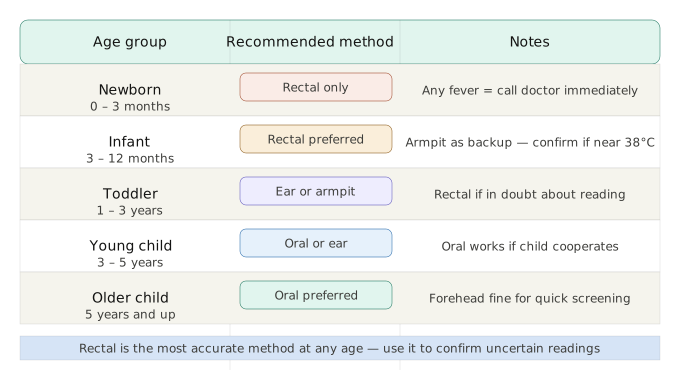
Which Method Should You Use? Age Makes All the Difference
Here's the most practical question most parents have: given everything above, which method should I actually use?
The honest answer is that it depends entirely on how old your child is.
Newborns (0–3 months): Rectal is the only recommended method for newborns. It's the most accurate, and accuracy at this age is non-negotiable. A normal newborn temperature rectally is between 36.6°C and 38°C. If you get a rectal temperature of 38°C or higher in a baby under 3 months, you call a doctor immediately, no waiting, no monitoring overnight.
Infants (3–12 months): Rectal is still preferred, but a digital thermometer under the arm becomes more practical for routine checks. If the armpit reading is close to fever threshold, confirm rectally. Normal baby temperature in this range sits between 36.5°C and 37.5°C regardless of method, with appropriate adjustments.
Toddlers (1–3 years): This is where it gets practical. Most parents find rectal readings at this age more challenging to do cooperatively, so ear thermometers or armpit readings with a digital thermometer become the go-to. If your toddler temperature chart readings consistently land above 38°C, that's a fever regardless of method.
Children (3–5 years): Oral thermometers become viable at this age because children can hold the thermometer under their tongue and breathe through their nose. Ear thermometers also work well.
Older children (5+): Oral is reliable and preferred. Forehead thermometers work fine for quick screening. This age group is also much better at communicating how they feel, which helps you put the temperature reading in context.
How to Take Temperature, Step by Step for Every Method
Knowing which thermometer to use is one thing. Using it correctly is another. These are the actual steps, broken down by method.
Rectal Temperature
This is the gold standard for accuracy, especially for rectal temperature baby readings. Here's how to do it safely.
Lay your baby on their back. Bend their legs toward their chest, or place them face-down across your lap. Apply a small amount of petroleum jelly (like Vaseline) to the tip of the thermometer. Insert the tip gently into the rectum, no more than 2.5 cm (about 1 inch) for infants. Hold it in place gently until it beeps. Never force it, and never let go of the thermometer while it's in place. Normal rectal temperature baby range is 36.6°C to 38°C.
After use, clean the thermometer with soap and water and alcohol, and store it separately from the thermometer you use for other methods. Label it clearly.
Oral Method
Wait at least 15 minutes after your child has eaten or had anything to drink before taking an oral reading, food and beverages, hot or cold, will affect the reading. Place the tip of the thermometer under the tongue, toward the back. Ask your child to close their lips gently around it and breathe through their nose. Hold still until it beeps. This method is only reliable for children old enough to cooperate, generally 4 years and up.
Armpit (Axillary) Temperature
The armpit method is the most commonly used backup method. It's easy to do on babies and toddlers, and while it's less accurate than rectal, it's fine for monitoring when combined with behavioral observation.
Remove your child's shirt or pull it away from the armpit. Place the thermometer tip in the center of the dry armpit, not against clothing or to the side. Bring the arm down firmly against the body. Hold the arm in place until the thermometer beeps. Baby armpit temperature readings should be interpreted with that 0.5°C adjustment in mind. A normal baby temperature armpit reading would be around 36.5°C to 37°C.
Ear Method
Pull the ear gently back and slightly up to straighten the ear canal (this is important for accuracy, skip this step and you'll get an inaccurate reading). Insert the probe tip gently into the ear canal and press the button. The reading comes in about a second. Check both ears, if there's wax buildup or recent ear infection, one ear may read differently from the other.
Forehead Method
Hold the thermometer flat against the center of your child's forehead. Scan slowly from the center to just in front of the ear (for scanning models) or simply hold in place (for non-contact models). Make sure the forehead is dry, wipe away sweat before measuring. A child who just came in from the cold outdoors should be allowed to warm up to room temperature for at least 15 minutes before you take a forehead reading.
Temperature-Taking Tips That Actually Make a Difference
These are the practical details that don't always come up in the instruction manual but matter in real life.
Always wash your hands before and after taking a temperature. Clean the thermometer before and after use. Don't share thermometers between family members without cleaning them between uses.
Timing matters. Temperature is naturally lower in the early morning and higher in the late afternoon, sometimes by as much as 0.5°C. If you take a reading at 6 a.m. and again at 5 p.m. and see a small difference, that's not necessarily the fever worsening, it might just be normal fluctuation.
Consistency in method is critical when you're tracking a fever over time. If you take the first reading orally and then switch to forehead for the next one, you can't meaningfully compare the numbers. Pick a method and stick with it throughout that illness.
Keep a temperature log. Write down the time, method used, and reading every time you check. When you call a nurse line like Health811 in Ontario or HealthLink BC, they'll ask you these questions, and having the information ready makes the conversation much more productive.
If a reading seems off, your child feels much hotter than the thermometer suggests, or feels fine but the thermometer reads high, take a second reading. A single unusual number is worth confirming before making any decisions based on it.
What Actually Causes Fever in Children
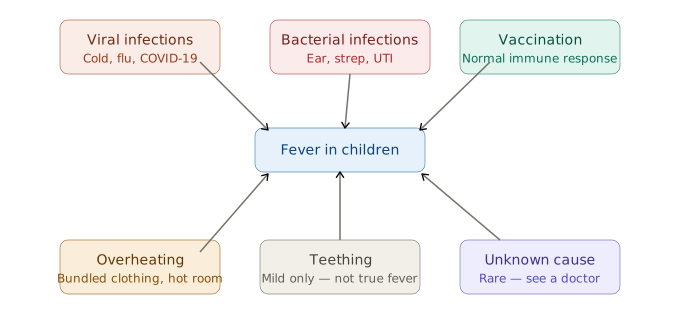
Fever is a symptom, not a disease. It's the body's response to something, and that something is usually one of a handful of common causes.
Viral infections are the most common cause of fever in children by far. Colds, flu, COVID-19, croup, and stomach bugs are all viral, and the fever you see with these is your child's immune system mounting a response. These fevers typically resolve on their own as the illness runs its course.
Bacterial infections can also cause fever, and these sometimes do require medical treatment. Ear infections, strep throat, urinary tract infections, and pneumonia are bacterial and may need antibiotics. A fever that's very high, doesn't improve after a few days, or comes with localized symptoms (like ear pain, difficulty swallowing, or pain when urinating) warrants a doctor's assessment.
Vaccinations commonly cause a mild fever, usually starting within 24 hours of the shot and resolving within a day or two. This is normal and expected. Yes, vaccines cause fever, that's actually a sign the immune system is responding to the vaccine the way it's supposed to. For fever management after vaccines, acetaminophen is generally recommended. Talk to your pharmacist or doctor.
Teething is one of the most persistent myths in parenting. While teething can cause mild discomfort and possibly a very slight temperature increase (up to about 37.2°C), it does not cause a true fever above 38°C. If your teething baby has a real fever, something else is going on and it should be investigated.
Overheating can also cause a rise in body temperature. A baby bundled up too tightly in a warm room, or a child who's been playing hard in the summer heat, might register a higher temperature that resolves quickly once they cool down. This is different from an infection-driven fever, the key distinction is context.
What to Do When Your Child Has a Fever
A fever diagnosis is not the moment to panic, it's the moment to shift into calm, systematic care mode. Here's what actually helps.
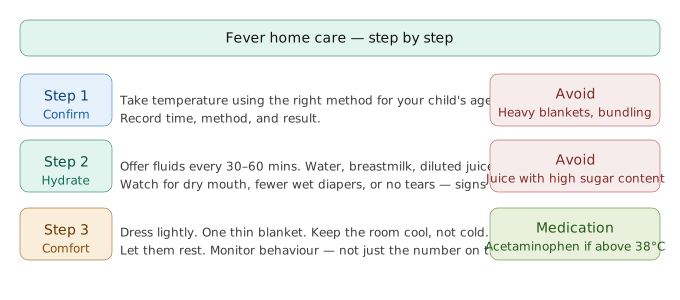
Keep them hydrated. This is the single most important thing you can do. Fever causes fluid loss, and children (especially infants and toddlers) can dehydrate faster than adults. Offer water, diluted juice, breastmilk, or formula frequently. Older children can have popsicles or broth. Watch for signs of dehydration: dry mouth, no tears when crying, reduced urination (fewer wet diapers), sunken eyes.
Dress them lightly. Despite the old instinct to bundle a feverish child, heavy clothing and thick blankets trap heat and make things worse. Light clothing and a single light blanket is enough.
Let them rest. Sleep is healing. Don't force activity. Keep the room comfortably cool, not cold, but not stuffy either.
Monitor behavior, not just temperature. This one is genuinely important. A child with a 39°C fever who is playing, drinking fluids, and responding to you normally is very different from a child with a 38.5°C fever who is limp, won't drink, and can't be consoled. The number on the thermometer tells part of the story. Your child's behavior tells the rest.
Night-time fever care. You don't have to wake a sleeping child to check their temperature on a fixed schedule. If they're sleeping comfortably, let them sleep. If they wake crying, feel very hot, or seem distressed, then check and respond. Sleep is restorative, interrupting it repeatedly doesn't help.
For additional guidance on sleep during illness and at other stages, the Baby and Toddler Sleep Age-by-Age Schedules resource at Little Groovers covers developmental sleep patterns that can help you understand what's normal.
Fever Medications, What's Safe, What Isn't, and How Much
Two medications are commonly used in Canada to manage fever in children: acetaminophen and ibuprofen. Both are available over the counter at any pharmacy without a prescription. Both are safe when used correctly. Both can cause harm when misused.
Acetaminophen (e.g., Tylenol, Tempra)
Acetaminophen can be used in children from 2 months of age onward. It reduces fever and relieves pain. The dose is based on the child's weight, not their age, this is important. Always read the label carefully and use the dosing tool included with the product (usually a syringe or cup). Give every 4–6 hours as needed, but never more than 5 times in 24 hours. Acetaminophen is available in infant drops (more concentrated) and children's liquid (less concentrated), make absolutely sure you're using the right product and the right dose for the right concentration.
Ibuprofen (e.g., Advil, Motrin for Children)
Ibuprofen is an anti-inflammatory that also reduces fever and relieves pain. It is not recommended for infants under 6 months. It's particularly useful for higher fevers because its effects tend to last slightly longer than acetaminophen (6–8 hours vs. 4–6 hours). Again, dose by weight. Ibuprofen should always be given with food or milk to reduce the chance of stomach upset.
What to Avoid
Never give aspirin to a child under 18 years old. This is a firm medical recommendation, aspirin is linked to a rare but serious condition called Reye's syndrome in children. Even if you've used it yourself, it's not appropriate for children.
Don't alternate acetaminophen and ibuprofen unless a healthcare provider specifically advises it. It can be confusing to track dosing and timing, and there's a real risk of accidentally overdosing on one of them.
If your child vomits shortly after taking medication, it's generally not recommended to immediately give a repeat dose, you can't know how much was absorbed. If vomiting is ongoing, call your nurse line for guidance.
When to Contact a Healthcare Provider
This is the section many parents come here looking for. The honest answer is: trust your gut, but also know the specific signs.
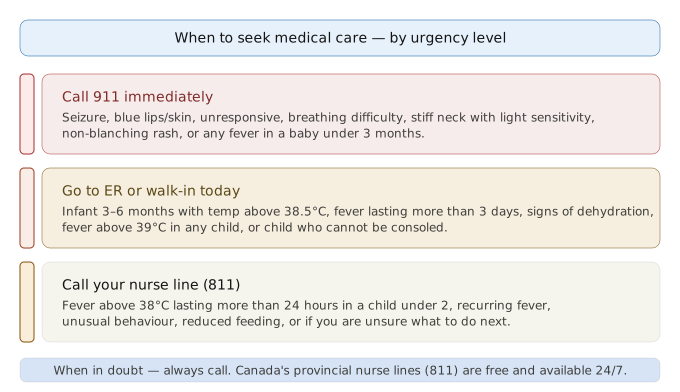
For babies under 3 months: Any fever of 38°C or higher is a reason to call or be seen immediately. No exceptions. The immune systems of very young infants are not equipped to fight off infections the same way older children are, and what looks like a minor illness can escalate quickly.
For babies 3–6 months: A temperature of 38.5°C or higher warrants a call to your healthcare provider, especially if it's been going on for more than 24 hours or if the baby seems unusually quiet, won't eat, or is very difficult to console.
For children 6 months and up: Contact your provider if the fever is above 39°C, has lasted more than 3 days, or is accompanied by symptoms like stiff neck, severe headache, rash, difficulty breathing, or persistent vomiting.
Signs of dehydration are always a reason to seek medical attention, regardless of temperature: very dry mouth, no tears, no wet diapers in 8 hours, sunken fontanelle in infants (the soft spot on top of the head).
Behavior changes matter more than the number. A child who is not responding normally, is unusually difficult to wake, or who is clearly in significant distress needs to be seen, full stop.
In Canada, you have several options for getting guidance without necessarily going to an ER. Many provinces have nurse hotlines available 24/7, HealthLink BC (811), Health811 in Ontario, and similar services in other provinces. These are staffed by registered nurses who can talk through your child's symptoms and help you decide whether you need to be seen in person.
Walk-in clinics are available in most Canadian cities and are a good option for non-emergency situations during daytime hours. For families living in or near Calgary, knowing which services are nearby can help, the Calgary Family Activities resource at Little Groovers covers local family resources and services worth bookmarking.
Emergency Signs, When You Call 911
There are situations where you do not wait, do not call a nurse line, and do not drive to a walk-in. You call 911 or get to an emergency department immediately.
Call 911 or go to the ER right away if your child:
Has a seizure (see the febrile seizures section below) Is breathing with difficulty, very fast, or is making unusual sounds when breathing Has lips or fingertips that look blue or pale Is completely unresponsive or cannot be woken Has a very stiff neck combined with sensitivity to light, this can be a sign of meningitis Has a non-blanching rash (a rash that doesn't fade when you press on it), also a potential sign of meningitis Is a newborn with any fever at all (38°C or higher rectally)
These are rare. But they're important. The time to learn these signs is now, not in the middle of a crisis.
Febrile Seizures, What They Are and What to Do
Febrile seizures are one of the most frightening things a parent can witness. They happen in about 2–5% of children, typically between the ages of 6 months and 5 years, and they're usually triggered by a rapid rise in temperature rather than the height of the fever itself.
A febrile seizure typically looks like this: the child loses consciousness, the body stiffens, and then jerks rhythmically. It usually lasts less than 5 minutes. It's terrifying to watch, but most febrile seizures are not dangerous by themselves and don't cause lasting harm.
What to do during a febrile seizure: Place your child on their side (the recovery position) on a flat, safe surface. Do not put anything in their mouth, not your hand, not a spoon, nothing. Do not hold them down or try to stop the jerking. Time the seizure. Keep the area clear so they don't hit anything.
After the seizure: Your child will likely be drowsy and confused. Stay calm, keep them comfortable, and call 911 if: the seizure lasted more than 5 minutes, it's their first seizure ever, they don't fully wake up afterward, or they have difficulty breathing once the seizure stops.
Any first-time seizure in a child should be evaluated medically, even if it seems mild. Your child's doctor will want to assess them.
Fever in Infants, Why the Rules Are Stricter
Infants under 3 months occupy a very different medical category from older babies and toddlers. Their immune systems are immature and their ability to fight infections, even ones that would be minor in older children, is significantly limited. This is why the guidelines for infant fever are much more conservative.
A fever in a baby under 3 months is a 38°C rectal temperature or higher. At this threshold, medical evaluation is required, this is not a wait-and-see situation. The concern is that what looks like a minor viral infection could actually be a bacterial infection that, at this age, can spread very quickly and become serious.
A normal newborn temperature rectally is between 36.6°C and 38°C. Normal baby temperature in general hovers around 36.5°C to 37.5°C depending on method. Anything that reads at or above 38°C rectally in the first three months is an urgent matter.
Infant fever temperature concerns also extend to how the baby is acting. A baby who is difficult to wake, refuses to feed, is unusually pale or limp, or who is crying inconsolably needs to be seen regardless of what the thermometer says.
Prevention and General Health Habits
You can't bubble-wrap your child. But you can build habits that reduce how often they get sick and make their immune system more capable when they do.
Hand hygiene is the single most effective way to prevent the spread of infections that cause fever. Teaching children to wash hands properly, with soap, for at least 20 seconds, especially after using the bathroom and before eating, makes a real difference.
Vaccinations are one of the most powerful tools available for protecting children's health. Canada's publicly funded immunization schedule is designed to protect against some of the most serious childhood illnesses. The fever that occasionally follows a vaccine is a small, short-term response that means the immune system is learning. The protection it builds lasts years.
Sleep and nutrition support immune function. Children who consistently get enough sleep and eat a varied diet are better equipped to fight off illness when they do encounter it. For parents navigating sleep routines at different ages, the baby and toddler sleep schedules guide at Little Groovers is a solid starting point.
Canada-Specific Guidance, Resources You Actually Need
Canada has a publicly funded healthcare system, which means most families can access medical care without out-of-pocket costs. But knowing how to navigate that system, especially at midnight when your toddler has a 39.5°C fever, is a skill worth having ahead of time.
Provincial nurse lines are available around the clock in most provinces. You can speak to a registered nurse, describe your child's symptoms, and get real-time guidance. In British Columbia, call 811 for HealthLink BC. In Ontario, 811 connects you to Health811. Other provinces have similar services.
Telehealth and virtual care has expanded significantly in Canada in recent years. Many family doctors now offer virtual appointments, and apps like Maple allow you to connect with a physician within minutes at any hour. These are excellent options for situations that need medical input but don't require a physical exam.
Walk-in clinics in most Canadian cities are open during daytime and evening hours and can assess and treat non-emergency illness. No referral is needed. If you're new to your city or haven't yet established a family doctor, these are your front-line option.
Emergency departments are for true emergencies, the signs listed earlier in this guide. They should not be your first call for a routine fever, both for your child's sake (waiting rooms during cold and flu season are not where you want a sick toddler) and for the healthcare system's sake.
For families exploring life with kids in Canada, the best family road trip destinations in Canada and indoor playgrounds in Calgary pages at Little Groovers are worth a browse for when your little one is fully recovered and back to their energetic self.
Final Thoughts
Fever is part of childhood. Every parent will navigate it dozens of times, some nights calmly, some nights with a lot of worry. Having the right information before those moments arrive makes an enormous difference.
The most important shift you can make is from watching the thermometer number to watching your child. Temperature is data, but it's only part of the picture. A child at 38.5°C who is drinking fluids, making eye contact, and able to be comforted is in a very different situation from a child at 38.5°C who is limp and unresponsive. Learn to read both.
Keep a working thermometer in your home. Know which method is appropriate for your child's age. Have your provincial nurse line number saved in your phone before you need it. And trust yourself, you know your child better than anyone.
When in doubt, reach out. That's what healthcare providers are there for.
For more practical parenting resources, guides, and family content, visit Little Groovers, a home for Canadian parents navigating all of it, one stage at a time.
Frequently Asked Questions
1. What temperature is a fever in Canada?
In Canada, a fever is defined as a body temperature of 38°C or higher. This is the threshold used by most Canadian pediatric and medical guidelines. The method of measurement matters, a rectal reading of 38°C is a true fever, while an armpit reading of 38°C likely corresponds to a real fever of closer to 38.5°C.
2. Which thermometer is most accurate?
Rectal thermometers are the most accurate, particularly for infants. Ear thermometers are a good second option when used correctly. Forehead thermometers are convenient but more prone to variation and are best used for quick screening rather than definitive readings.
3. Can fever harm my child?
A fever itself is rarely harmful. Fever is a natural immune response. The underlying cause of the fever is what may need treatment. Very high fevers (above 40°C) sustained for long periods can occasionally cause discomfort, but brief high fevers in otherwise healthy children are not known to cause brain damage. The concern is always about what's causing the fever, not the fever itself.
4. How often should I check temperature?
During an active fever, checking every 4–6 hours is generally sufficient unless your child seems to be deteriorating. You don't need to check every hour, that level of monitoring will exhaust you and disturb your child unnecessarily.
5. Can teething cause fever?
No. Teething can cause mild gum discomfort and sometimes a very slight rise in temperature (up to about 37.2°C), but it does not cause a real fever above 38°C. If your teething baby has a genuine fever, the cause is something else, typically a viral infection.
6. When should I go to hospital?
Go to the ER if your child has a seizure, has difficulty breathing, has blue lips or skin, is unresponsive, or is under 3 months old with a fever of 38°C or higher. For other serious concerns, calling a provincial nurse line first is a reasonable step that can help you decide.
7. Is 39°C dangerous?
A 39°C fever in a child over 6 months who is drinking, responsive, and not showing other alarming signs is generally manageable at home with monitoring. It does warrant more careful observation and likely a call to your healthcare provider if it persists beyond 2–3 days or if the child's behavior changes.
8. Can I use both medicines together?
Alternating acetaminophen and ibuprofen is sometimes done, but it's easy to make dosing errors and should only be done if a healthcare provider specifically recommends it for your child. Using both without guidance increases the risk of accidental overdose.
9. Should I wake my child to take their temperature?
Not necessarily. If your child is sleeping comfortably, let them sleep, rest is important for recovery. If they wake seeming distressed or you notice they feel very hot, then check. In infants under 3 months, you should check temperature if they feel warm at any point, even if sleeping.
10. How long does fever last?
Most viral fevers in children last 3–5 days. Bacterial infections may cause fever that persists longer and often require treatment. A fever that's been going on for more than 5 days without an identified cause is reason to consult a doctor.
11. Is forehead thermometer reliable?
Forehead thermometers are convenient and fine for quick screening, but they can be thrown off by sweat, cold skin, drafts, and other environmental factors. If a forehead reading concerns you, confirm with a digital rectal or oral thermometer.
12. What is low-grade fever?
A low-grade fever generally refers to a temperature between 37.5°C and 38°C. It's above the normal range but below the standard fever threshold. It often indicates the early stages of illness or a mild immune response and warrants monitoring without necessarily requiring medication.
13. Can weather cause fever?
Cold weather doesn't directly cause fever, you can't catch a cold from being cold. Illnesses spread more easily in winter partly because people spend more time indoors in close proximity. Exposure to viruses, not cold air, is what causes infection-driven fever. Overheating in hot weather can cause body temperature to rise, but this is heat exhaustion or heat stroke, not an infection-based fever.
14. What if fever keeps coming back?
A fever that keeps returning after resolving, particularly over the course of a week or more, is something your doctor should know about. Recurring fevers can sometimes indicate an underlying infection that wasn't fully treated, or less commonly, other medical conditions that need investigation.
15. Can vaccines cause fever?
Yes. Many vaccines produce a mild fever as a normal part of the immune response. This typically appears within 24 hours and resolves within 1–2 days. It's a sign the vaccine is working. Acetaminophen can be given for comfort. Talk to your pharmacist about timing and dosage.